
When the yard cracks open in August and a gap appears between the soil and your slab, it's natural to grab the hose. That instinct is mostly right. On the clay around New Braunfels, keeping the soil evenly moist through a dry spell is one of the few things a homeowner can do to keep a foundation from moving.
But watering a foundation is easy to get wrong. Too little does nothing. Too much in one spot can cause the very movement you're trying to stop. And the rules on when and how you can water change from town to town. This guide pulls together what engineers agree on, what each local water utility allows, and how to turn that into a routine that fits your house.
Water evenly, gently and only when the ground is dry. A Houston engineers' association says to water one to two feet away from the foundation, and New Braunfels Utilities allows a soaker or drip line within 24 inches of it, so a line laid 12 to 24 inches from the slab satisfies both. Uniform moisture all the way around the house is the goal. On clay, it matters a great deal. On thin soil over rock, it matters much less, and leaks and runoff deserve more of your attention.
Key facts
- New Braunfels Utilities lets foundations be watered up to two hours on any day in Stage 2, by hand or by a non-spraying soaker or drip line within 24 inches.
- The Foundation Performance Association says to water at least one to two feet from the foundation, lightly, and only in dry periods.
- The Texas engineers' guidelines warn against excessive watering.
- August is the hottest month in New Braunfels, with an average high of 94.6°F.
Why Watering Matters on Clay
Clay swells when it's wet and shrinks when it dries. A slab sitting on clay rides those changes. The trouble comes when the soil changes unevenly: the edge of the house dries out through a hot summer while the soil under the middle stays damp, or one corner stays wet from a leak while the rest dries.
The Foundation Performance Association, a group of engineers and repair professionals in Houston, sums it up in one line in its maintenance guide: uniformity is the key. That means uniform moisture in the soil, kept the same on all sides of the foundation.
That's why watering matters so much around New Braunfels. In our sample of the USDA soil survey, 40% of the city sat on clay rated very high for shrink and swell. Under Branyon clay, the most common soil in the city, that very high layer runs from about a foot down to past 6 feet. A dry August can pull a lot of water out of that clay, and August is the hottest month in New Braunfels, with an average high of 94.6°F.
On the limestone side of town, the picture is different. Comfort soil has bedrock about 13 inches down, and there's far less soil to swell and shrink. Watering still keeps plants alive, but it does much less for the foundation. On that ground, the bigger risks are water you don't control: a leaking pipe, runoff from a slope, or a downspout emptying against the wall. Our guide to New Braunfels soil shows how to check which side your lot is on.
What Engineers Agree On
Two Texas sources set out the basics. The Foundation Performance Association wrote its maintenance guide for southeast Texas, so treat it as practical advice, not a local rule. The guidelines from the Texas section of the American Society of Civil Engineers cover the whole state.
Water when it's dry, and lightly. The association says to water the soil around the foundation during dry weather, when lawn grass starts to wilt. The watering should be done at least one to two feet away from the foundation, and then lightly, so tree roots aren't drawn toward the house.
Don't overdo it. The Texas engineers' guidelines say keeping soil moisture near uniform on all sides of the foundation may help, and also warn against excessive watering. Too much water can cause heave, where wet clay swells and pushes part of a slab up.
Don't fill the gap. If the soil has cracked and pulled away from the foundation in a long dry spell, the association says not to water directly into the gap.
Keep sprinklers off the house. The association says not to let sprinklers spray water against the structure.
Know your equipment. In a separate paper on design options, the association lists the trade-offs:
- Soaker hoses put water into the soil more slowly than sprinklers and are the easiest to install. They can also cause too much or uneven moisture if they're not watched, can draw roots toward the foundation, and can wear out early. Burying them can cut evaporation and protect them from mowers.
- Drip systems are recommended with a moisture meter, so you can see what the soil is actually doing.
- Sprinkler systems can overwater if nobody's watching, and can spray the house.
The association also recommends a soil moisture sensor with automatic controls for any watering system. It also says drought rules can stop these systems from running at all.
Where to Put the Hose
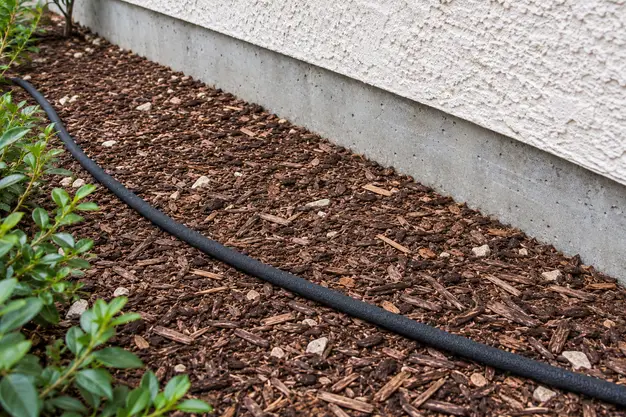
Here's where the local rules and the engineers' advice meet. New Braunfels Utilities allows a soaker hose or drip line "placed within 24 inches of the foundation". The Foundation Performance Association says to water at least one to two feet away from it. A line laid somewhere between 12 and 24 inches from the slab fits both.
A few more points from the same sources help the water go where you want it:
- Run the line all the way around. Uniform means every side, not just the side you see from the kitchen window.
- Mulch over it. The association recommends a ground cover such as mulch around the foundation, extending at least five feet out.
- Don't dam it in. Avoid metal edging or other barriers within five feet of the foundation, which can trap water against the slab.
- Slope the soil away. The Texas guidelines call for the ground to fall at least 5%, about 6 inches over 10 feet, for the first 10 feet around the house, where that's practical.
How Much, and How Often
There's no single number that fits every house, and we won't invent one. What the sources give you instead is a way to judge it.
Start when the ground is dry, not on a calendar. The association's trigger is grass beginning to wilt. Water gently, and check the soil a few inches down afterward. A drip line with a moisture meter, as the association suggests, takes the guessing out of it. If the soil near the foundation stays soggy or water pools on the surface, you're watering too much.
Watch the house as well as the yard. The association recommends checking the house and site twice a year, after the driest and wettest stretches, and taking photos of every outside wall to record how they look. Doors that stick only in late summer, or cracks that open in August and close by spring, suggest the soil under the house is moving with the seasons.
Watering Rules Town by Town
Every town around New Braunfels sets its own watering rules, and only some of them mention foundations. Here's what each city's own page or plan said when we read it on October 6 and 7, 2026. Stages change often, so check your city before you plan.
- New Braunfels (New Braunfels Utilities): Stage 2 since August 10, 2026. Foundations may be watered up to two hours on any day, during watering times, by handheld hose, or by a soaker hose or drip system within 24 inches of the foundation that doesn't spray water above the ground. Stages follow the Edwards Aquifer's J-17 well and the flow of Comal Springs.
- Seguin: the city's 2024 drought plan doesn't mention foundations. Year round, outdoor watering is banned from 10 a.m. to 8 p.m., except with a handheld hose or a drip irrigation system, which you can use at any time.
- Kyle: in Stage 3, watering around foundations with a soaker hose is permitted on any day.
- San Marcos: in Stage 3, foundation watering by drip system, soaker hose or hand-held hose is allowed only one day a week.
- Schertz: on the Carrizo Aquifer, which the city says isn't under drought stages. Its ordinance treats watering right next to a concrete foundation, to prevent damage, as separate from yard watering, and allows it before 8 a.m. and after 8 p.m. even in Stage 3.
- Universal City: in Stage 3, a handheld hose is allowed at any time. No foundation rule.
- Live Oak: in Stage 3, a hand-held hose is allowed any time on any day. No foundation rule.
- Garden Ridge: its drought plan allows a hand-held hose, drip line or soaker hose any day, any time, with no stage declared or in Stage 1, and on fewer days and hours in Stages 2 and 3. No foundation rule.
- Cibolo: year-round limits on irrigation system hours, and no sprinklers on Sundays. Its page doesn't mention hoses, drip lines or foundations.
- Selma, Converse and Canyon Lake: we couldn't find current rules from the city or water provider, so ask before you set up a system.
The pattern is useful. Where a city's rules don't name foundations, a handheld hose is usually the method allowed at the most hours. Where they do, the rule tends to favor a soaker or drip line close to the slab.
Trees, Downspouts and Leaks
Watering is only half of keeping the soil even. The other half is controlling water and roots you didn't plan for.
Downspouts. The association's checklist says downspouts should carry water at least five to ten feet away from the house. The Texas guidelines add that downspouts shouldn't feed into perforated underground drain pipe.
Leaks. Leaking plumbing, drains, dripping faucets, air conditioner drain lines and broken gutters can all create a wet spot by the foundation, the association says, and should be fixed as soon as possible. A wet spot next to a dry one is exactly the uneven moisture you're trying to avoid.
Trees. Big trees pull a lot of water out of clay. The association's checklist suggests no broadleaf tree, such as an oak or pecan, closer to the house than its own height, and pruning to keep larger trees in check. The Texas guidelines add a caution: removing a large tree, especially one older than the house, can let the clay swell back up and cause heave. Pruning may be the safer choice, and the guidelines suggest asking an arborist.
When Watering Isn't Enough
Watering can slow movement, but it can't undo damage that's already done. If cracks keep growing, doors keep sticking through wet and dry seasons, or the floors slope more each year, it's time to have someone measure the floors. A foundation inspection will show whether the house is still moving, and whether slab foundation repair is needed.
Foundation Watering Questions
Is foundation watering allowed during drought restrictions in New Braunfels?
Yes. When we checked, New Braunfels Utilities was in Stage 2, and its rules allow foundations to be watered up to two hours on any day, during watering times, by handheld hose or by a non-spraying soaker or drip line within 24 inches.
How far from the foundation should a soaker hose go?
Between 12 and 24 inches fits both the engineers' advice and the New Braunfels Utilities rule. The Foundation Performance Association says to water at least one to two feet away, and NBU allows a line within 24 inches.
Can watering my foundation cause damage?
It can, if it's uneven or too heavy. The Texas engineers' guidelines warn against excessive watering, and the Foundation Performance Association says soaker hoses can cause excessive and uneven moisture if they're not watched.
Should I water into the crack between the soil and my slab?
No. The Foundation Performance Association says not to water directly into the gap when soil pulls away from the foundation in a dry spell. Water the soil a foot or two out, gently.
Do I need to water if my house is on rock?
Much less. On thin soil over limestone, like Comfort with bedrock about 13 inches down, there's little clay to shrink. Keeping water away from the foundation, and fixing leaks, matters more there than adding water.
If you're already seeing signs of movement, a free inspection is a good place to start.