
If your house is on a post-tension slab, you may have heard warnings that make it sound fragile, or even dangerous. It isn't. Living on one is no different from living on any other slab. The cables inside only matter when someone wants to cut or drill into the concrete, and that's exactly what a repair, a remodel or a new plumbing line can involve.
Around New Braunfels, this comes up a lot. About 69.3% of the city's homes were built in 1990 or later, so many are likely to have one. This guide explains what a post-tension slab is, how to tell if you have one, and what changes when it cracks or needs repair.
A post-tension slab has steel cables running through the concrete, pulled tight after it sets. The Post-Tensioning Institute says its design method for these slabs on expansive soil has been used on millions of homes since 1980. Day-to-day living doesn't touch the cables, but no one should cut, drill or core into the slab without first finding where they run. Many slabs carry a warning stamp, often in the garage floor. Outside piers usually work the same as on any slab. Work inside the house needs more care.
Key facts
- The Post-Tensioning Institute's design method for post-tension slabs on expansive soil dates from 1980 and has been used on millions of homes.
- The International Building Code says post-tensioned slabs on expansive soil must follow the Post-Tensioning Institute's design standard.
- A trade publication, Concrete Network, describes cables pulled to 33,000 pounds.
- About 69.3% of New Braunfels homes were built in 1990 or later.
What a Post-Tension Slab Is
A conventional slab has steel bars set in the concrete before it's poured. A post-tension slab uses steel cables, called tendons, that are pulled tight once the concrete has set.
Concrete Network describes each cable as seven high-strength steel wires wound together inside a plastic sleeve. It says a cable can be pulled to 33,000 pounds, stretching about 8 inches over a 100-foot run. The anchors that hold each end sit in pockets at the edge of the slab, and those pockets are filled with grout to protect them from rust.
The design method matters on clay. The Post-Tensioning Institute says it built a standalone design guide for these slabs on expansive soils in 1980, and that the model building codes later adopted it. Its technical note quotes the International Building Code: post-tensioned slabs on expansive soils shall be designed to the institute's standard.
Inside a post-tension slab
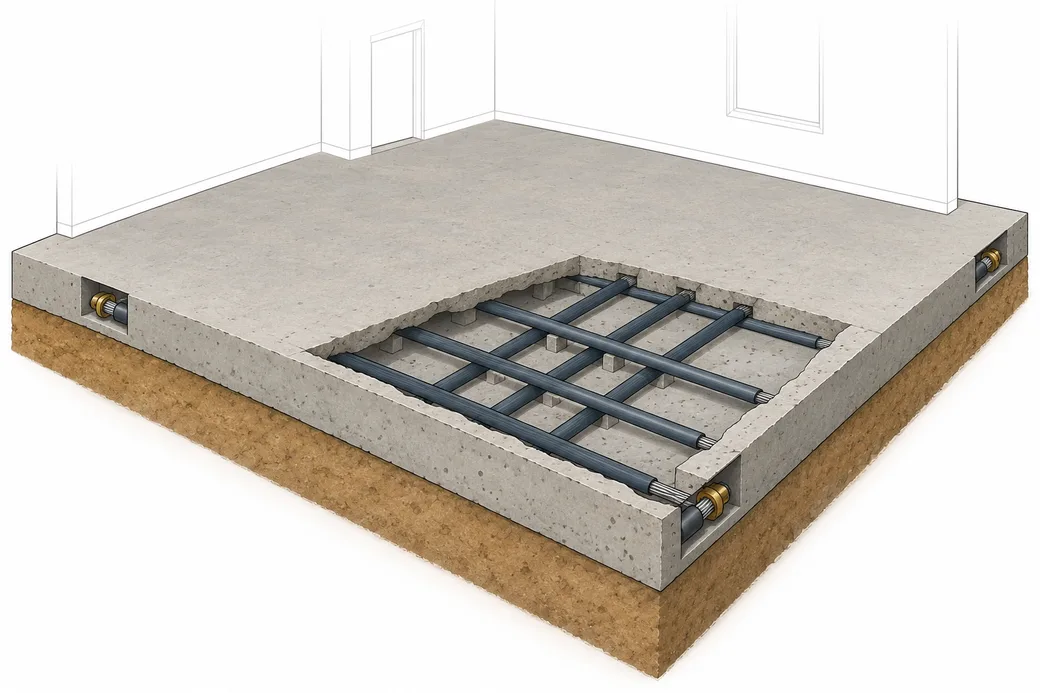
- Steel cables run through the slab in both directions
- Each cable ends at an anchor at the slab edge
- The slab is one piece, poured on the ground
Is My Slab Post-Tension?
There are a few ways to find out, and none of them needs a tool.
Look for a stamp. Many post-tension slabs carry a warning stamp. Industry sources say it's usually in the garage floor, often just inside where the garage door comes down. The spot isn't the same on every house, so walk the whole opening. On some older homes, the warning was only a plastic or paper sign near the garage door, which may be long gone.
Look along the edge. Round patches spaced along the outside edge of the slab can cover the cable ends.
Check your papers. Builder documents or closing papers may say what kind of slab you have. In New Braunfels, a 2022 city notice says the city asks for an engineer's foundation inspection letter during the inspections for new homes. If your house is recent, the city's project record may help.
Ask for an inspection. If none of that settles it, a foundation inspection will. Age is a clue, not an answer: a house from the 1990s or later is more likely to be post-tension, but that's a trend, not a fact about your house.
Why the Cables Matter
The cables stay under heavy load for as long as the slab stands. Concrete Network warns not to cut or drill into post-tensioned concrete, because once a cable has been cut, it is very difficult to repair.
The Post-Tensioning Institute does publish methods for splicing a damaged cable, using new sleeve or heat-shrink tubing over the repair. That's specialist work, and far better avoided than needed.
The practical answer is simple. Before anyone drills, cores or saws into the slab, the cables should be found first. Industry sources say they can be located with a scanner. A car lift maker's install guide puts it bluntly, in a warning headed "post-tension slab: do not cut or core".
What Changes in a Repair
Outside piers. Many slab repairs put piers under the edge of the house from outside, then lift and shim. That work doesn't cut into the slab itself, so it works much the same on a post-tension slab as on any other. Our slab foundation repair page walks through the steps.
Inside piers and plumbing. Piers inside the house, and plumbing repairs under the slab, mean breaking through the concrete. On a post-tension slab, the cables should be located before any cutting starts. It's fair to ask any contractor how they'll find them.
Testing the cables. The guidelines Texas engineers use list post-tension cable testing among the tests in their most detailed inspection level. If you're worried about the cables themselves, that's the level to ask an engineer about.
After a lift. Whatever the slab type, the Texas engineers' guidelines call for leak tests on the water and sewer lines after any lift, and a floor survey to record where the house ended up.
Cable Ends and Rust
The cable ends sit in grouted pockets at the slab edge, and the cables run inside plastic sleeves. The Post-Tensioning Institute says moisture that gets into a cable's sleeve can wear away its coating and eventually rust the steel strand.
So it's worth a look along the edge of your slab now and then. If a patch over a cable end has cracked open, or you see rust stains, point it out at your next inspection. Keeping water away from the slab edge, with downspouts and grading that carry it off, helps here as much as it helps with clay.
Living on a Post-Tension Slab
Daily living never touches the cables. An industry guide for real estate agents says the warning is about cutting or drilling during a renovation, not about living in the house.
The times to stop and check are the ones that go into the concrete: a new plumbing line, a floor drain, a safe or a car lift bolted to the garage floor, or interior foundation work. For each of those, find the cables first.
On clay, a post-tension slab still moves with the soil. The Post-Tensioning Institute says a slab's long-term performance depends on good drainage and on the owner keeping the soil moisture steady. Around New Braunfels, where 40% of our USDA sample points landed on very high shrink-swell clay, that advice matters. Our foundation watering guide shows how.
Post-Tension Slab Questions
Is a post-tension slab dangerous to live on?
No. An industry guide for real estate agents says the warnings are about cutting or drilling during renovation, and normal daily living isn't affected.
Can a post-tension slab be repaired?
Yes. Outside piers and a lift work much as they do on any slab. Work that cuts into the slab needs the cables found first, and a cut cable can be spliced, though it's specialist work.
How do I find the post-tension stamp?
Industry sources say it's usually in the garage floor, often near where the garage door comes down. Walk the whole opening, because the spot varies, and check the slab edge for round patches over the cable ends.
Can I drill into my garage floor to mount something?
Not until the cables are located. Industry sources say they can be found with a scanner, and a car lift maker warns against cutting or coring a post-tension slab.
Does a post-tension slab stop foundation movement on clay?
No. It's designed for expansive soil, but the Post-Tensioning Institute says its long-term performance still depends on drainage and steady soil moisture.
If you're seeing cracks or sticking doors, a free inspection is a good place to start.